

PERSEPOLINA (November 2026)
Driven by a search for justice, Persepolina, a young princess from ancient Persia, sets out on a journey through the epochs of our world.
Along her travels, Persepolina encounters a wide range of societies and ideas. She witnesses the emergence of democracy, explores how political ideals can grow and fail, comes to understand kingdoms, dictatorships, and the idea of communism, and ultimately glimpses a future in which artificial intelligence takes on political decision-making.
Guided by a sharp mind and an open outlook, Persepolina learns to listen closely, think independently, and trust her inner voice. Her journey is both timeless and deeply relevant: a story about justice, shifting perspectives, and the realization that even a single young voice can shape the course of history.
Rich in imagination and deeply rooted in cultural heritage, Persepolina invites children and adults alike to ask big questions.

School After Superintelligence (August 2026)
Two years, five years, fifteen years from now?
No one knows when artificial intelligence will surpass human beings at every cognitive task that schools have traditionally been built around. But schools cannot afford to wait until it happens.
For two hundred years, education has had a clear purpose: prepare children for productive life. Schools were factories for the future workforce, organized around knowledge transfer, measurable skills, and the credentials that opened doors to employment. That model shaped the classroom, the timetable, the textbook, the test, and the professional identity of the teacher.
If artificial intelligence can teach, tutor, assess, and personalize learning better than any classroom can, and if the economy no longer needs what schools were designed to produce, then education faces the most important question in its modern history:
What is school for?
School After Superintelligence explores five possible futures for education: some hopeful, some alarming, and one that asks what learning means when usefulness is no longer the answer. It is a book about the end of knowledge scarcity, the danger of reducing schools to efficient delivery systems, and the urgent need to protect school as a human institution in the age of machine intelligence.

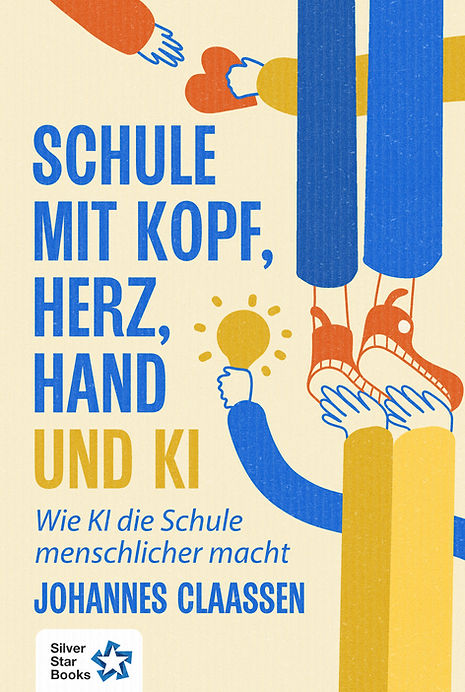
AI MAKES SCHOOLS MORE HUMAN German
More than 200 years ago, Johann Heinrich Pestalozzi envisioned an education that engages head, heart, and hand. Since then, the world has changed radically, yet his vision remains unfulfilled. Ironically, artificial intelligence could help make schools more human at last, if we use it wisely. AI has the potential to free education from one of its greatest constraints: inefficient knowledge transmission.
When AI tutors provide content in a personalized and adaptive way, something precious emerges: time. Time for teachers to inspire curiosity, strengthen students’ sense of self-efficacy, and design projects with real-world relevance.
This book poses an uncomfortable question: What if AI is not the real problem, but rather a school system that still clings to uniformity and standardized testing, even though better alternatives have long been within reach?

More books coming soon